EQ Types: The Stuff That Actually Matters
Parametric, passive, shelving—what the differences actually are and why you should care.
I've built EQ plugins. I've modeled vintage hardware. I've spent way too long arguing about filter slopes in Discord servers. Here's what I've learned about EQ types that actually matters for making music.
Most EQ "Types" Are Marketing
Let me be blunt: a lot of what gets labeled as different EQ "types" in plugins is just different curves and some saturation slapped on top. The words "vintage" and "analog" have become meaningless. I've seen plugins called "tube EQ" that have zero tube modeling—just some harmonic distortion and a warm color palette.
That said, there ARE real differences between EQ types. Let's talk about them.
Parametric EQ: The Surgeon's Scalpel
Parametric gives you three controls per band: frequency, gain, and Q (bandwidth). You can target exactly what you want.
This is what I reach for when something's wrong. Resonant frequency at 3.2kHz making the vocal harsh? Narrow Q, cut it out. Boxy 400Hz buildup in the room mics? Find it, kill it.
The trap with parametric is using it for everything. Just because you CAN make surgical cuts doesn't mean you should. Narrow boosts sound weird. Really narrow boosts sound like resonant filters. Use wide Q for boosts, narrow Q for cuts. Always.
Also: if you're boosting more than 3-4dB with parametric EQ, you're probably fixing the wrong problem.
Shelving EQ: The Broad Strokes
Shelves boost or cut everything above (high shelf) or below (low shelf) a certain frequency. They're for tonal balance, not problem-solving.
High shelf at 8-10kHz: "more air, more presence, more expensive-sounding"
Low shelf at 100Hz: "more weight, more thump, more mud if you overdo it"
Shelves are underrated. A gentle high shelf does more for a mix than most surgical EQ moves. When I master, I probably use shelves 10x more than bells.
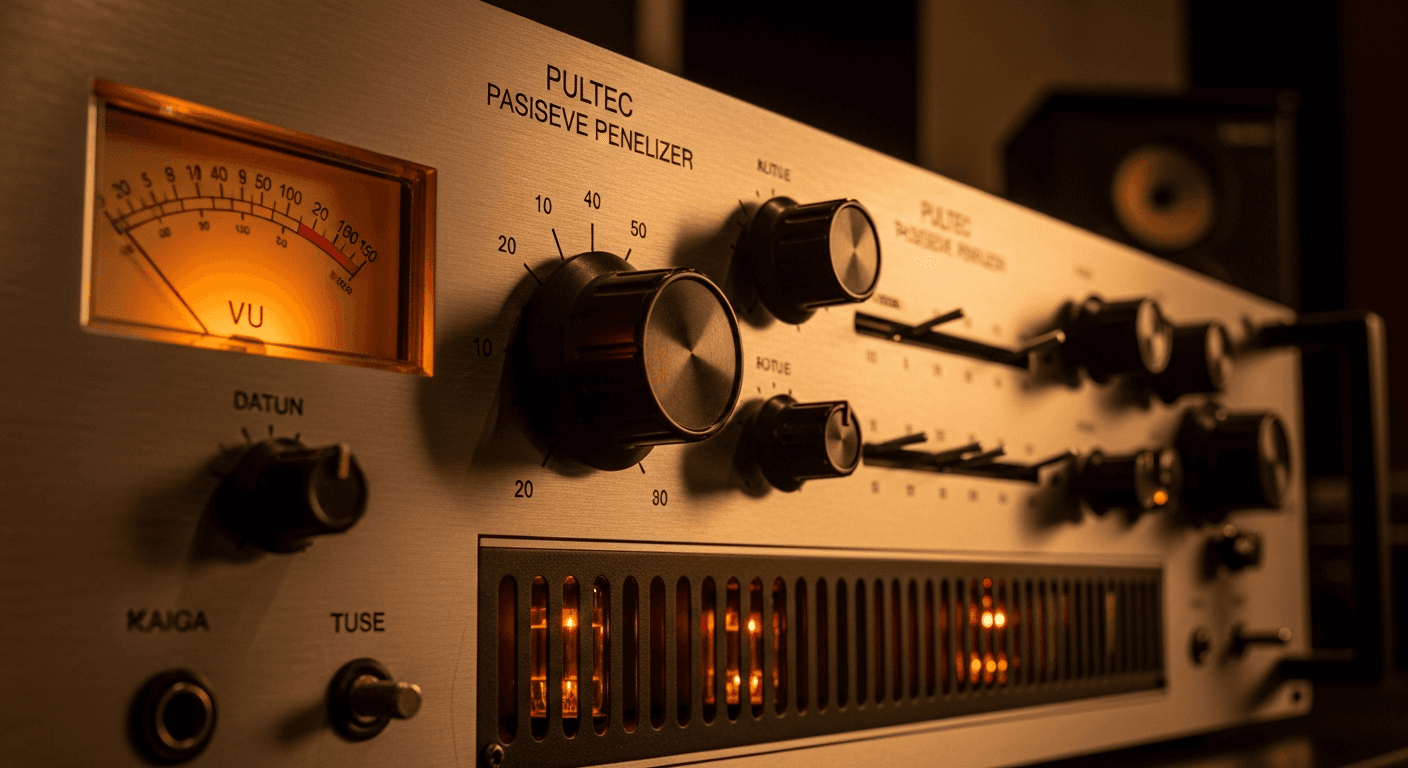
The Pultec trick everyone talks about—boosting and cutting at the same low frequency—works because of how shelves interact. The boost hits first, the cut hits the sub-bass. You get punch without mud. It's not magic, it's just phase relationships and curve shapes. But it works.
Passive EQ: Why Old Stuff Sounds Different
Real passive EQs (Pultec, Neve 1073, etc.) use inductors and capacitors instead of op-amps. The curves aren't symmetrical. Boosting at 3kHz doesn't look like a mirror image of cutting at 3kHz.
This asymmetry is what makes them "musical." The curves are gentler, the interactions between bands are complex, and you can push them harder without things getting weird.
When I modeled the Ember EQ, this was the hard part—not the frequency response, but the feel. How the bands interact. How the saturation changes with level. It's not just "add some harmonics." It's understanding how the components behave.
Modern plugins can do this well. They can also fake it poorly. If a "passive EQ" plugin looks like perfect parametric curves when you analyze it, it's not really modeling passive behavior.
Dynamic EQ: The Problem Solver
Dynamic EQ only kicks in when the signal crosses a threshold. It's EQ meets compression.
I use it for:
- De-essing (cut 6-8kHz only when sibilants hit)
- Taming resonances that come and go
- Controlling bass that's inconsistent
If you're making static EQ moves to fix a dynamic problem, you're fighting the wrong fight. That vocal that's sometimes harsh? Don't cut 3kHz across the board—you'll make it dull when it wasn't harsh. Use dynamic EQ.
What I Actually Use
For mixing: Stock parametric EQ for problem-solving, passive-style EQ (or my own Ember EQ) for tone shaping, dynamic EQ for inconsistent issues.
For mastering: Mostly shelves. Gentle. 1-2dB moves max. If I'm doing more than that, the mix has problems.
Here's the thing: the EQ type matters less than using your ears. I've heard great mixes done entirely with stock DAW EQ. I've heard terrible mixes with $500 worth of plugin EQs.
The tool doesn't make the decision. You do.
The Uncomfortable Truth
Most EQ moves in amateur mixes are unnecessary. People EQ because they think they should, not because something's wrong.
Before you reach for an EQ, ask: is there actually a problem? Or am I just tweaking because I'm bored?
The best EQ move is often no EQ at all. Get the source right, get the arrangement right, and you might find there's nothing to fix.
Related Articles
Analog Modeling: How Plugins Get That Sound
What actually happens inside analog-modeled plugins. The DSP behind harmonic distortion, transformers, and tube warmth.
How to Use Reference Tracks: The Pro Mixing Secret
Reference tracks are how professionals avoid mix blindness. Learn to use them effectively without losing your own sound.
Delay Settings for Vocals: From Subtle to Dramatic
How to use delay on vocals without creating a muddy mess. Practical settings for slap, tempo-sync, and throw delays.